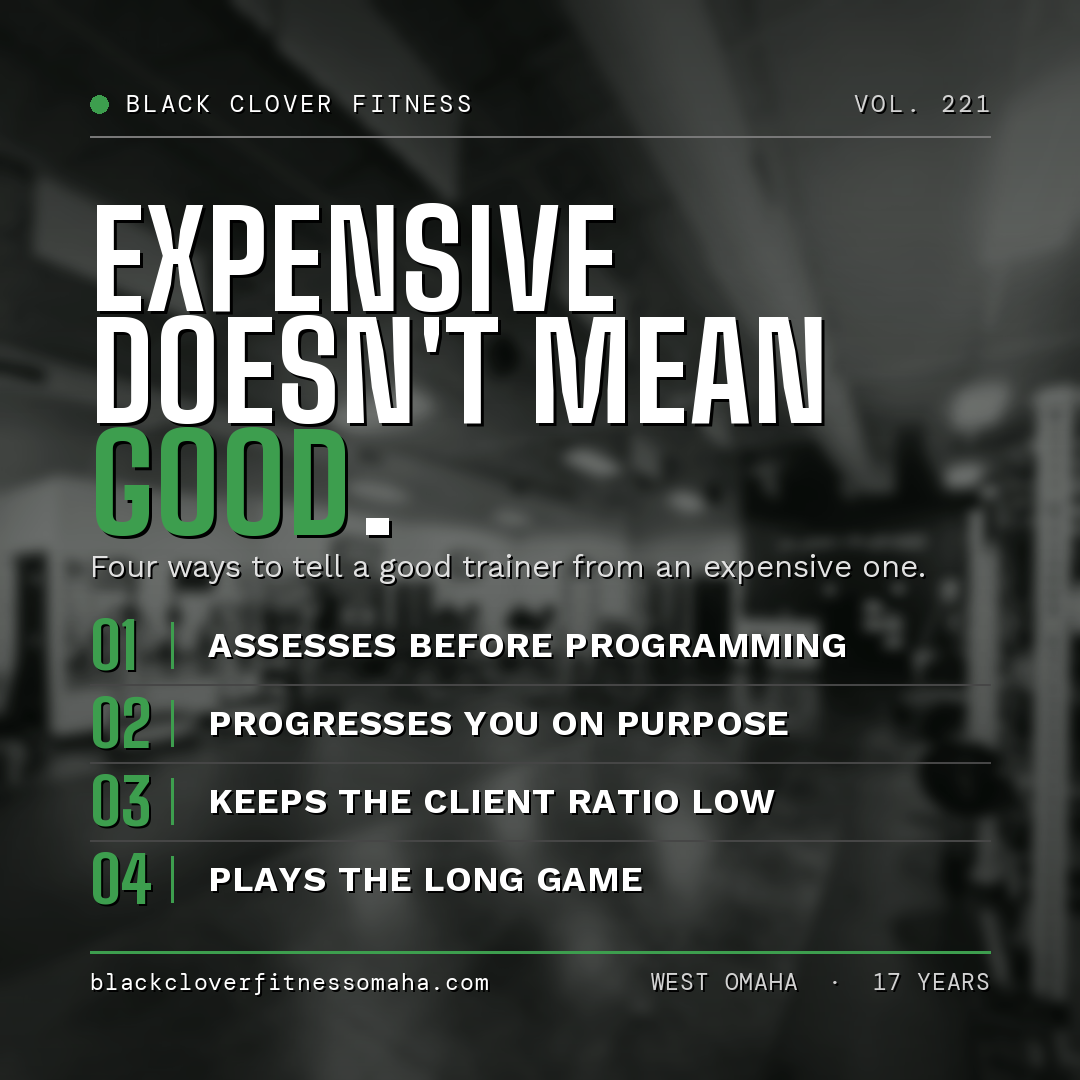
A high price doesn't guarantee good coaching, and a busy gym floor doesn't mean anyone's watching you. Here's how to tell the difference — before you spend a dime.
Plenty of people are open to working with a trainer — they just don't want to get burned. That's the correct instinct. The problem is that price and packed class sizes are terrible signals of quality. So instead of asking "is it worth it," ask a sharper question: how do I tell a good trainer from an expensive one? Four things separate them.
01. THEY ASSESS BEFORE THEY PROGRAM
A good trainer learns your history, injuries, goals, and how your body moves before writing a single workout. If your first session is a hard workout instead of an honest assessment, that's a flag.
02. THEY PROGRESS YOU ON PURPOSE
The goal isn't to make you sore — anyone can do that. It's to make you measurably stronger over weeks and months. If you can't point to what's improved, you're being entertained, not coached.
03. THEY CAN ACTUALLY SEE YOU
Ask how many people the coach watches at once. A trainer splitting attention across fifteen can't correct your form or adjust your load in real time — which is exactly when people over 50 get hurt. The ratio matters more than the logo on the wall.
04. THEY PLAY THE LONG GAME
A good trainer cares whether you're still training in two years, not whether today wrecked you. Adherence beats intensity every time — the best program is the one you can sustain.
"The best program is the one you can sustain."
WE DIDN'T WRITE THAT LIST TO DESCRIBE OURSELVES
— but it happens to describe how we've worked for 17 years in West Omaha. Every Black Clover Fitness client starts with an assessment. Our semi-private model caps each coach at four clients, so Connor and Jordan can actually watch your form and load you correctly. Sessions are 45 minutes, built on progressive overload, and designed for the long haul — not to wreck you for a day, but to keep you strong for decades. Hold any trainer up to those four tells. We're confident in how we measure up.