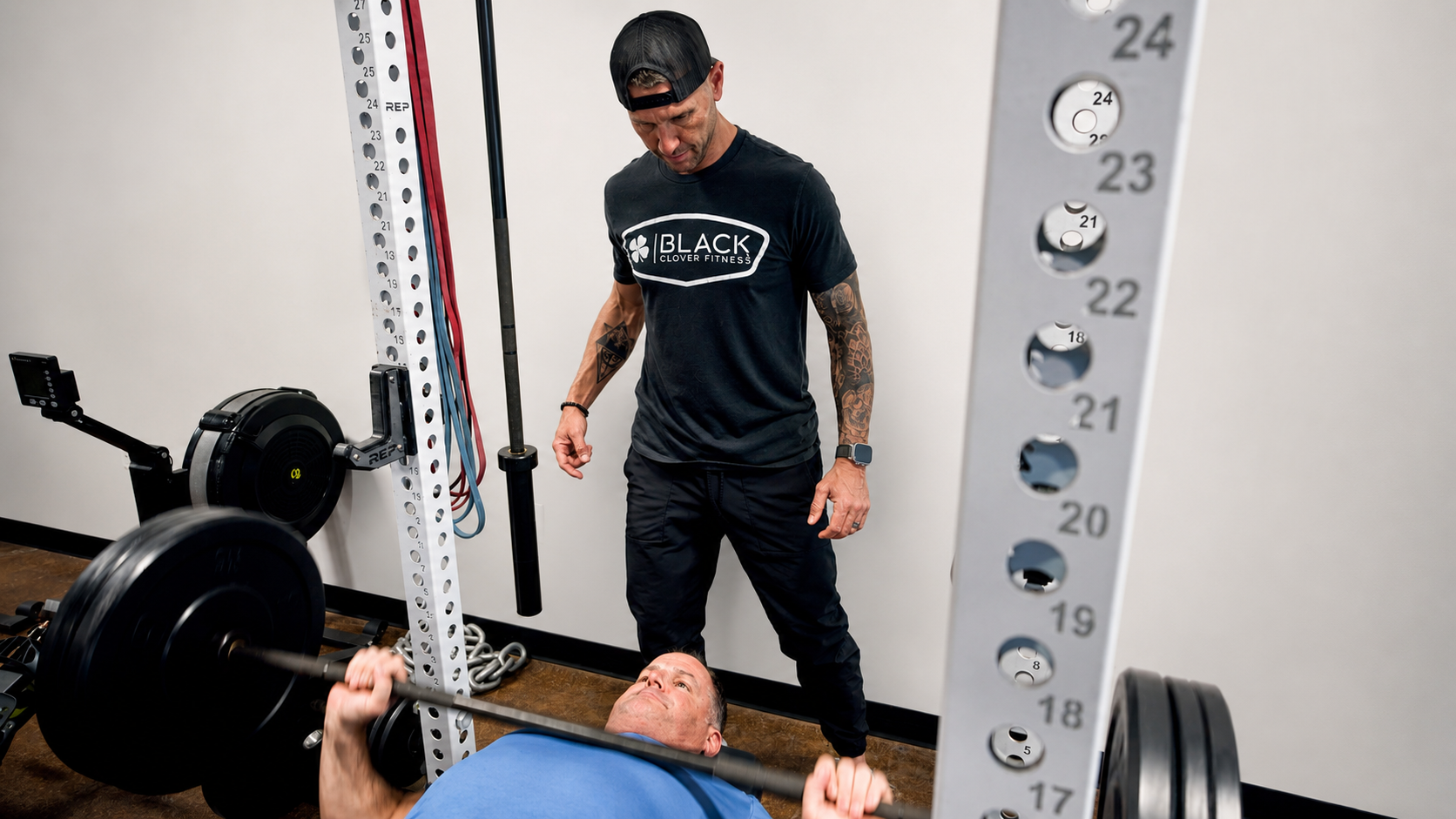
It's the question we get more than any other. So we sat down and asked it directly. No marketing spin. The same answer he'd give a friend at a barbecue.
It's the question we get more than any other — at networking events, from family members, from prospects sitting across from Trevor in their first consultation. So we sat down and asked it directly. No marketing spin. The same answer he'd give a friend at a barbecue.
Here's the conversation.
01. Is personal training actually worth the money — yes or no?
Yes — but only if you and the trainer are the right fit. If you've struggled to hit your goals year in and year out, hit a plateau you can't break through, or honestly have no idea what to do with functional strength training, a coach absolutely helps.
The catch — and this is what separates a good trainer from a bad one — is that trainer has to meet you where you currently are. Not where you want to be five years down the road. Anyone who hands you a program built for a version of you that doesn't exist yet is setting you up to fail.
02. Who is personal training NOT worth it for?
Two types of people. The "I've tried everything" person — they walk in saying they've tried every workout under the sun and a half-dozen trainers with no results. That's a red flag, but not for the reason you'd think. It's not the workouts. It's not the trainers. The common denominator is the person standing in front of me. Until they're willing to look at themselves honestly, no program is going to change anything.
And the know-it-all. If you walk in already convinced you know better than the coach you're paying, you've wasted your money before you've even started. Coaching only works if you're willing to learn and adapt. That's not me being harsh — that's me respecting your time and mine. We don't take every client who walks through our doors. The fit has to be there.
03. What's the biggest misconception about what people are paying for?
That a couple of hours a week with a trainer is going to change their life — and change it fast. It won't. Not on its own.
There are 168 hours in a week. If you spend two of them in the gym, that's it — two. The other 166 are still yours. What you do with those 166 hours matters as much as what we do together in session — probably more.
Most people did not get into poor shape overnight. The results aren't going to come overnight either. No amount of time with a great trainer will make up for 166 hours of poor sleep, processed food, no movement, and unmanaged stress.
"Most people didn't get into poor shape overnight. The results aren't coming overnight either."
04. There's a huge price range in this industry. What are people actually paying for at each tier?
Tier one is your 24-hour access gym — around $30 a month. You're paying for equipment and a door that unlocks at 4 a.m. If you genuinely know what you're doing and can motivate yourself, that's a fine option.
Tier two is your typical boutique studio. Quality varies a lot. Most focus on metrics that don't really move the needle — constant heart rate monitoring, calorie burn, getting through the workout as fast as possible. You leave a sweaty mess and feel fantastic. But feeling great isn't the same as building muscle.
Tier three is where BCF lives — programmed semi-private training. Each client has a program built off their actual five-rep max so we can add progressive overload week by week. There's no guessing. It's calculated. We program with a purpose. You're lifting because lifting creates longevity.
"Feeling good after a workout isn't the same as getting results."
05. How do I vet a trainer so I don't waste my money?
Check longevity. The average fitness studio doesn't make it past three years. New, flashy concepts open all the time — most of them are fads. If a facility has been around for a decade-plus, that's a real signal.
Check certifications and experience. Ask who they've worked with. Ask what a typical session looks like. Ask what they'd do differently than what you've already tried — because if they can't answer that question, they don't actually have a plan for you.
Trust your gut on personality. You need to enjoy being there and take it seriously. The connection has to be there from the first consultation. We're all decent judges of character — if something feels off, it probably is.
Make sure the plan scales. A good coach doesn't throw you into the deep end on day one to prove how hard they can make you sweat. The plan should work toward your goal in the long run.
06. BCF serves mostly clients between 40 and 70. Does the math change after 40?
Completely. After age 30, your body atrophies muscle at roughly 3% per year if you're not doing anything to maintain it. That's not a scare tactic — that's biology. Cardio doesn't fix it. Walking doesn't fix it. Only resistance training does.
Yes, recovery is slower than it was in your 20s. You'll feel it more. But the ROI on strength training after 40 is exponentially higher — because you're not chasing aesthetics anymore. You're adding functional years to your life. You're buying back independence at 70. You're investing in years with your grandkids.
Start before your doctor is the one telling you that you need to.
"Don't wait until the doctor is the one telling you."
07. What does the client have to bring to the table for this to actually work?
Discipline. You can't out-train a bad diet. I don't care how hard you work in the gym three or four days a week — if you're following it up with a pitcher of margaritas and bottomless chips and salsa on the weekend, the math isn't going to work.
At BCF, we calculate every client's basal metabolic rate from day one and build a nutrition protocol off of it. But I'm not coming to your house to cook for you. I'm not measuring your food. That's on you. If we're not progressing in the facility, the first place to look is in the mirror.
The clients who put forth 100% are the ones who change. The clients who half-commit get half-results — and then wonder why training "didn't work" for them.
08. What's the moment in 20 years that shaped how you coach today?
The biggest thing for me is meeting people where they are right now — not rushing them into where they want to be too quickly.
Social media these days is full of influencers doing stupid movements that look cool on camera but provide zero benefit. Unrealistic stuff made for show. All for likes and clicks.
Twenty years in this industry has taught me that if we start clients off too strenuous, they get too sore, start questioning their motives, and want to quit before we can progress the program. A majority of clients don't need a punishing protocol. They need patience. They're making a lifestyle change — that takes time.
09. Out of all the clients you've coached, who's the one whose story sticks with you?
We've trained clients who've lost 50, 75, even over 100 pounds. We've coached All-American athletes and Olympic alternates. But the client who motivates me the most isn't any of them.
His name is Neil. Neil comes in twice a week in a motorized wheelchair, and he never misses a session. He knows his strength training is adding years to his life. He can't do everything — but he busts his ass to do everything within his power to do what he can.
There are days I personally don't feel like working out. Then I think about Neil — who's dealing with circumstances a lot harder than mine — showing up without complaint. He motivates me when I need it most. If Neil can show up, you can show up.
10. Final question. If someone reads this and they're still not ready to invest in coaching, what's the one thing you'd tell them?
Get outside and start walking. Build up your endurance. Get some sunlight. Cut the sugar. Eat protein-rich foods. Let your body slowly adapt. Then start adding functional strength training two to three days a week. It doesn't need to be brutal — it just needs to put your body in motion and start building muscle.
Because muscle is longevity. You have to find a way to build it as you age, before it's too late.
I tell my clients this all the time, and I know it sounds ridiculous: when we're working their lower body and they complain about their legs being sore, I tell them I'm helping them get up off the toilet 20 years from now. It may hurt sitting down. It may hurt standing up. But I'm going to make sure you can always do it — without having to call your neighbor for help.
That's what strength training is really for. Not the mirror. Not the scale. Your independence.