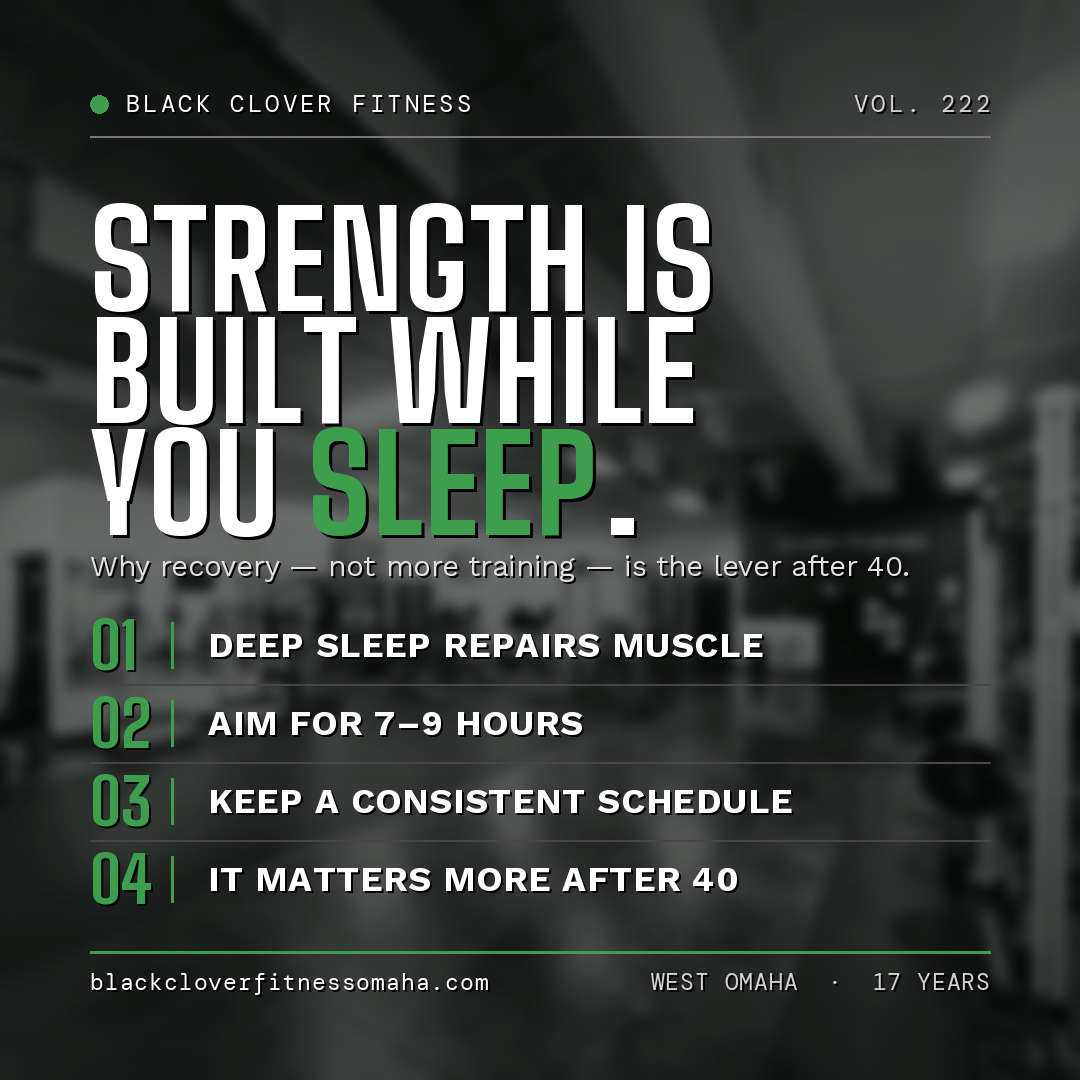
Your muscle isn't built in the gym — it's built while you recover. Here's the highest-leverage recovery tool most adults over 40 are wasting.
Your muscle isn't built in the gym — it's built while you recover. Here's the highest-leverage recovery tool most adults over 40 are wasting.
"A single night of poor sleep has been shown to cut muscle protein synthesis — the repair that makes you stronger — by roughly 18%. You can train perfectly and undo part of it overnight."
DEEP SLEEP
When most of your daily growth hormone is released — the signal that drives muscle repair, tissue regeneration, and bone maintenance. It declines naturally with age.
NERVOUS SYSTEM RESET
Sleep restores your brain's ability to recruit muscle efficiently. Under-sleep and power, reaction time, and balance all degrade — strength is more than muscle.
WHY IT MATTERS MORE AFTER 40
Two things stack against you with age. Deep sleep naturally declines, so you produce less growth hormone even on a full night. And the hormones that support muscle are already trending down — in one study, restricting sleep to about five hours a night for a single week dropped testosterone levels by 10 to 15%.
The recovery you could shortcut at 30 is no longer optional at 55. Sleep moves from "nice to have" to a core part of the program — the foundation that makes the training work.
HOW TO ACTUALLY IMPROVE IT
Consistency beats duration. A regular sleep and wake time — even on weekends — does more for deep sleep than occasionally sleeping in. Aim for a 7 to 9 hour window and protect it like an appointment.
Keep the room cool and dark. Cut caffeine after early afternoon. And be honest about alcohol — it may help you fall asleep, but it measurably suppresses the deep sleep where recovery actually happens.
None of it is glamorous. It's also the highest-leverage, lowest-cost change most adults can make to get more out of the training they're already doing.
HOW RECOVERY SHAPES OUR PROGRAMMING
This is why we don't try to wreck people in every session. Our 45-minute semi-private model is built on progressive overload with enough recovery built in that your body can actually adapt — because training you can't recover from isn't training, it's accumulated fatigue.
When a member stops progressing, sleep and recovery are among the first things we look at — not just the program. For adults 40 to 70 in West Omaha, that long-view approach is why it keeps working.